Zer0net 2024 Changes

A lot of these details only pertain to Zer0net node SysOps, however a huge part of this announcement is extremely relevant to any perspective new nodes, and none of it is anything in any way sensitive, so I’m posting this for all to read.
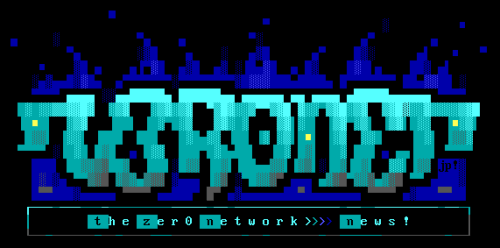
Zer0net font by Jack Phlash

It will be no surprise to many of you to read that I’ve been tossing around a lot of ideas about how to overhaul or otherwise update Zer0net for a couple of years now. We’ve had some interesting ideas, like shifting to a highly moderated structure and even focusing on new/different themes. In the end, I feel that Zer0net should stay true to, and in fact embrace, its identity as a network that values free speech even if that means taking the bad along with the good when it comes to open conversation, and staying true to our underground BBS scene aligned roots, and instead of changing the conversation, focus on having more of it. With that in mind, here’s what is changing with Zer0net in 2024, which, by the way, marks the network’s 25th birthday!

  • Paulie420 of 2o fOr beeRS will be joining me as the co-admin of Zer0net. I’ve greatly always appreciated help from others, and while Zer0net isn’t exactly a democracy, more often than not I poll our node operators for feedback on changes and other concerns about the network, and even work with some of them quite closely. While that won’t be changing, I believe that having another person, especially one with a different background, different values, and a different personality than me helping officially steer things can only be a good thing for the network’s future.

    Paulie will be highly involved with recruiting new nodes, reviewing applications, and otherwise working with prospective new members. He already does a lot of work helping and mentoring other SysOps, and generally trying to be involved in the whole BBS scene community, so this is a natural fit for him, and it’s especially important given a change detailed in a couple more paragraphs. The apply AT zer0net.org address we currently have in our documentation is still the best way to apply for the moment, and it will forward to him as well as me now.

    Also because he doesn’t pimp it nearly enough, and it’s pertinent to the interests of the readers of this blog, here’s his YouTube channel!

  • Esc AKA Ryan of Monterey and maintainer of the Daydream BBS software will also be officially joining the network’s staff. Of those Zer0net node operators I mentioned above, I’ve probably leaned most heavily on my friend Esc for many years now. He’s also joined me as one of the members of the relaunched Demonic Productions in 2022. Overall, he’s been one of the network’s most steadfast contributors for quite some time, and I wanted to recognize that. Speaking of both things, he runs Demonic’s small, private Discord server, and we have a Zer0net channel if any SysOps or frequent posters would like to join – just ask!
  • Zer0net has been opened up, and acceptance criteria has been loosened considerably. Ultimately, most of us are members of echo mail networks in order to be able to participate in more active conversations with a wider variety of people than just what is happening in our local message bases with our local users, even those of us lucky enough to have very active local message areas. Having an “elite” membership when (more times than not) we have very little active conversation, seems a bit self-defeating.

    Additionally, we’ve rejected quite a few boards that haven’t met our criteria over the years, but since one of the possible acceptance criteria is a lot of message activity, if those boards are relatively new, or the SysOp themselves is one of the most active posters, as is often the case, they never really get a chance to prove themselves before being rejected. While it has regrettably sometimes been taken this way, our mission here has never been to snub or otherwise discourage new SysOps, so this change should also help to address this issue.

    That said, we still want serious SysOps who are going to be around more than a month or two, and we still want nodes who will actually add something to the network rather than membership just being one more thing they can list on their advertisements. And uh, yeah, we’re still going to be pretty damn judgemental of totally stock boards. Sorry, we can’t help ourselves on that one! 🙂

    In the spirit of the old system, Zer0net will have two classes of member nodes:

    1. Elite status nodes are boards that meet our original criteria: great artwork and/or modifications, with an underground feel, notable affiliations and/or staff, a lot of activity in form of posts and/or other contributions, etc. All current and legacy nodes will be grandfathered in as elite status boards. Elite status boards do not need to meet any sort of minimal activity level, and can come and go as they wish, just as today.
    2. Normal status nodes are boards that do not necessarily meet the old, more strict criteria but we’ve decided to accept regardless. They must maintain a minimal level of activity (that is, we want to see new posts originating from the node!) We’ll do a quarterly or bi-yearly review of activity and any normal board who has not been active will be put into probationary status. The SysOp will be notified and if that status hasn’t changed by the next review, they’ll be removed.

    Normal status boards can be promoted to elite status. If they’ve proven themselves to have been highly active or otherwise grown to meet our original criteria. SysOps can ask for us to review their nodes for this, but more often than not we’ll proactively reach out to them if we feel they’ve earned a change in status.

    I’m not exactly expecting the floodgates to open, as it were, but then we have rejected a lot of nodes over the years, and I’ve told quite a few to hold off on their applications until these changes are finally implemented in the last year or so, so who knows!?

  • Echo housekeeping! In with the old and out with the slightly less old?

    It’s been quite a while since we’ve done this, so as a quick reminder of the point of this type of thing, like a fine dining restaurant with a small, focused menu, I strongly believe that less is more when it comes to message areas. That is, I’d rather have a small list of echos with broader topics, each with at least some activity, than have dozens upon dozens of echos dedicated to more specific topics, the majority of them entirely dead.

    1. This one is a long time coming. We’ll be removing the 0N-INFO and 0N-NEWS echos which have been around since the very beginning. Both echos have grown to feel redundant to me over the years, as most posts about the network’s administration will go into 0N-SYSOP anyway, and anything else more often than not winds up in our general discussion echo, 0N-CHAT.
    2. Similarly, we’ll be merging 0N-ANARC, 0N-HACKN, and 0N-PHRKN into the all encompassing new echo 0N-HPCAV. On paper, these echos have always been some of my favorites since the network started, but in reality these are seldom used as there simply isn’t as much crossover between the retro BBS scene and this stuff as I imagined. That was even true in the late 90s, as multiple BBS related underground disciplines had long been diverging into their own distinct scenes. Even when we do have users who want to go in depth on some of these topics, I’d imagine many of them don’t feel that an FTN network is the most secure place to do so. Still, Zer0net will always be aligned with the underground, and that’s not changing. At the very least, news related to security events always make for fun discussion.
    3. We’ll be adding a new echo, 0N-RETRO related to all things retro-computing. This one might ALSO feel redundant, but while BBSing in 2024 is undeniably “retro”, what most of us have been doing in the BBS scene is just an extension of what we were doing back in the dial-up days. The huge boom in retro-computing in the last 5+ years feels entirely distinct, with a lot more people, both in the scene and outside of the scene, taking an interest in vintage hardware and software, including jumping into the world of BBSing. A great number of us here are into retro computing and/or gaming to some degree, including myself, Paulie, and Esc, so I’m confident that this can be a place for some good conversations. As with our other echos, the actual intention of this echo will be a bit broader than that, with any conversations about vintage OR retro-targeted hardware, alternative OSes, software, games, emulation, etc. all being appropriate.
    4. With the aforementioned low-key rebirth of Demonic Productions back in 2022, we had previously added two new echos, 0N-DPUB and 0N-DPRI. 0N-DPUB is for public discussions and release announcements regarding Demonic Productions releases and related topics, while 0N-DPRI is, as the name might suggest, a private echo for Demonic members only, and because it requires special permissions, is not included in the echo list. Still, I’d love for anyone who hasn’t added it to make sure 0N-DPUB has been added to their boards.

  • File Fun!

    First, for those of you who care way too much about this sort of thing, I will endeavor to start doing a better job updating our nodelist file and infopack more or less in real-time as we add and remove nodes. I’ve already automated this process somewhat, including publishing them to Zer0net’s website for those of you who’d like to automate updates via wget (or whatever.) The biggest component of this, however, is that we’ll finally be adding a small number of file echos to the network:

    • 0N-NODEL – This will contain the latest Zer0net uncompressed nodelist file auto-hatched using the same filename every time, which should make it very easy for individual nodes to automate consuming them.
    • 0N-INFOP – This will contain the latest, most up to date version of the Zer0net infopack, again, using the same filename, always available to reference, distribute, etc. As with the last revision in 2020, this includes a variety of documentation regarding the network, some information and useful files for its setup, and some awesome artwork that you can use to give your system look as cool as it surely is if it’s a member of Zer0net.
    • 0N-DMNIC – New Demonic Productions releases will be hatched in this echo as they’re released. Speaking of which, we’ll have a new batch of releases very soon!

    Initially, no one will be linked to these new file echos by default, as previously our nodes were not configured with TIC passwords or other configuration needed to support file tossing. While I have made these changes on the hub side I don’t want to make any assumptions about your configurations, nor do I want to spam you with .TIC files and junk files you don’t want. Please use FileFix via a netmail to 911:1423/0 to add any desired echos when/if you’re ready to start receiving file hatches. Initially, your TIC password will be the same as those used for PKTs, AreaFix, or if you had nothing but defaults for those, BinkP.

  • There’s a lot of changes here, and given that some of our legacy nodes are more or less on autopilot, I won’t be nuking any of these old echos immediately. Instead, you’ll have until August 1st, 2024 to make any of the appropriate changes. A whole month! That said, these new message echos and file echos will be available immediately. Given all of these changes, there is a new major revision of our infopack (including an updated nodelist) coming… now! Yep, it’s released as of the posting of this announcement. Go grab it!

TL;DR version: Expect to see much more Paulie420 around. We have a Discord server! Expect to see a lot more new nodes and hopefully more posts, but this should not impact existing nodes. A new infopack is out! Please remove 0N-INFO, 0N-NEWS, 0N-ANARC, 0N-HACKN, and 0N-PHRKN from your configurations and add 0N-HPCAV and 0N-RETRO (and 0N-DPUB if you haven’t already done so.) Oh, and please fix that shit by August! If you’d like to receive file hatches of network nodelists, infopacks, and/or Demonic Productions releases, please configure your system to support TIC processing, add the new file echos 0N-NODEL, 0N-INFOP, and/or 0N-DMNIC, and link them via FileFix. Later!

Hawk Hubbard

This is an edited version of a spur of the moment message I posted to Zer0net the day I found out, updated and posted here for posterity.

By now, most of the people reading have already seen the news, or at the very least, knew that Hawk had been struggling with both heart issues and liver cancer for some time now. If not, I wanted to pass on the very sad news that on June 27th, the legendary Brian “Hawk” Hubbard passed on. I didn’t know Hawk as well as many people in the BBS and particularly art scenes did, so forgive me for not being able to write a legitimate eulogy, but I still feel compelled to say more.

A Toast to The Captain by Misfit and Ungenannt

Hawk, better known to most in the BBS scene back then as “Captain Hood“, and I crossed paths quite a few times in the late 90s and early 2000s. I recall email exchanges in which he wanted help setting up his own echomail network, locating some old esoteric Illness releases, that kind of thing. We always had a friendly, mutually respectful relationship, though it was always pretty casual so I can’t say he and I ever got to know each other well. He was, as I mentioned, already a bit of a legend by then; an absolute fixture in scene IRC channels like #acid, and his name was constantly popping up in group member and distro lists, greets on ANSI and ASCIIs, and in zines and e-mags for as long as I can remember, and truthfully, I don’t expect that to change even now.

Hawk was an ardent supporter of the scene, often encouraging and complimenting artists and supporting art groups, and in the post 2000s scene he was almost always in the mix of whatever new and exciting group or other project was in the works. I believe he was actually quite instrumental in making sure the BBS and art scenes, which had been diverging since the 1990s, remained undeniably linked. He was a (if not the) dude who artists loved to draw for (I mean, who else has multiple tribute pieces like the ones shown here?!) yet his involvement had always centered around his BBSes. This seemed to be the case even in the 1990s, looking at all of the amazing art he’d gathered and how many different affils his board had even back then. In the post 2000s scene, however, this got some of the top tier ANSI artists, who largely stopped taking requests or otherwise drawing more utilitarian art, to draw for ACTUAL BBSes again, which I’m sure also rippled out to influencing other artists to do pieces for other boards too.

Outside of the art scene, Hawk is known by many today for his impressive fleet (or armada, as he called it) of BBSes. He had multiple different systems over the years, each completely decked out with themed ANSIs and ASCIIs, including sick Oblivion/2 and PCBoard setups, and a RIPscrip focused Searchlight system. I remember calling the original Piranha when he first put it up on telnet full-time (and possibly earlier via dial-up, though my memory is a bit hazy there) and recall being absolutely floored by all of the amazing art he’d gathered and the modding he’d done. He later gained a bit of much deserved notoriety outside of the scene after 2013 when he launched Piranha: Under the Black Flag (AKA, just “Black Flag“) which was timed perfectly to gain notice from the growing retro computing scene, with Black Flag often showing up in various articles with lists of “must call” telnet BBSes. Black Flag was frequently at the #1 spot.

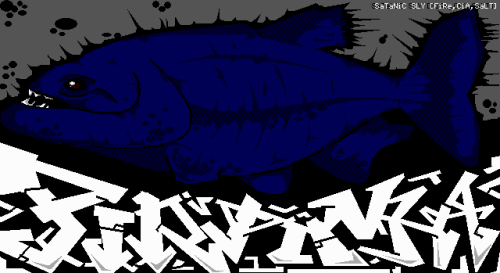
Piranha RIP by Satanic Sly

It was after a relaunch of the original Piranha around 2011 that Hawk joined Zer0net. With countless chats that usually started with troubleshooting or otherwise tweaking his echomail setups, this is when Hawk and I got to know each other a bit better. I’m proud to say that just about every system in Hawk’s mighty armada was also a member of Zer0net at one time or another. In fact, as I write this, his boards still occupy a ridiculous 4 slots in our node list! 😅

I should also definitely mention that all 4 of those BBSes that Hawk still had up (the aforementioned Piranha and Black Flag, plus Acid Underworld and The Black Tower) actually remain up, and hopefully will remain up in memorial to Hawk for quite sometime, as Hawk had moved away from hosting his BBSes locally with the help of Slime City BBS SysOp m00p. While it won’t be quite the same to call one of his BBSes without an extremely good chance of having Hawk break into chat with you, I think the whole scene is happy to know that his BBSes aren’t going to just unceremoniously disappear. Thanks m00p!

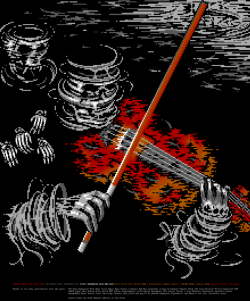
The Fiddler - Under the Black Flag by Whazzit

Of course, there’s a whole lot more to Hawk than I can really go into, most notably his life as a fiddle player and member of various bands, and all of the travels and other adventures he had around those times. Smooth actually created an echo on Araknet called “True Adventures” exclusively for Hawk to share all of those wild stories and otherwise wax philosophical about life. I only wish he used it more, as some of the few stories he had posted there and elsewhere were pretty damn incredible.

Likewise, I wish I knew more about Hawk and his history with the scene. How in the hell did he go from a fiddle player in Indiana to the SysOp of one of the sickest BBSes in Florida? I’d love to know more about how he first got into computers, his early days as a BBSer, and how he wound up being associated with the underground scene, and particularly ACiD Productions. As I mentioned briefly back in my 2022 update post, I’d been planning to do sort of mini-BBS reviews, complete with interviews with SysOps for this blog, and still hope to someday, but I’d always intended for Hawk and his fleet of awesome BBSes to be my first subject. Hawk and I talked a bit about it early last year, and when I first heard about him getting sick back in January, I scrambled to put together a lengthy Q&A style interview for him to work on whenever he felt up to it. He definitely seemed into the idea, but no doubt had much higher priorities in the months since, and I’m sure his energy was sapped much of the time from fighting the good fight on top of that. The truth is, he certainly didn’t need my help being immortalized in the scene!

Rest in Peace, Captain! You will not be forgotten.


1. we-a_toast_to_the_captain.ans by Misfit and Ungenannt from Blocktronics Acid Trip (2013)
2. ss-pira!.rip by Satanic Sly from CiA #37 (1996)
3. wz – the fiddler – under the black flag.ans by Whazzit from Blocktronics Blockfury (2015)

The First Four

Maybe it’s the holidays, but I was recently hit by a random streak of nostalgia around my family’s first ever computer, the Commodore VIC-20. I’m guessing it was sometime around 1985 or 1986 that my dad, almost certainly inspired by another family that we became friends with, the father being a huge Commodore 64 nerd, brought us home a VIC-20. We quickly amassed some game cartridges, a tape deck and a couple of tapes filled with demos and games, a joystick, and soon enough a Zenith ZVM-123 monochrome monitor so my brother and I weren’t tying up the family TV. I thought it would be fun to go back and revisit those first four cartridge-based games. This is where it all started for me!

Fast Eddie Commodore VIC-20

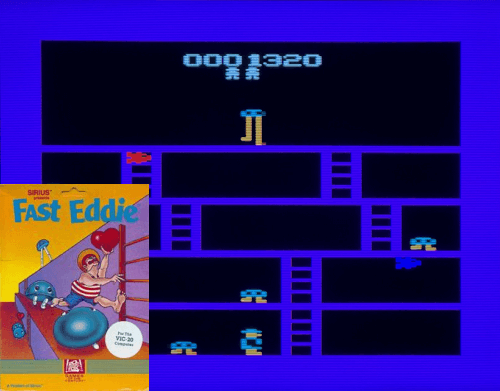
Fast Eddie is a single screen side-perspective platformer similar to more well-known titles like Lode Runner, Jumpman, and Donkey Kong. Your objective is to avoid these little mushroom looking “Sneaker” dudes while you climb ladders up and down multiple levels collecting “prizes” that appear at random. There’s a really tall Sneaker on the top level (called the “High-Top”) who will shrink in height with each prize you collect, eventually getting short enough for Eddie to jump over, which completes the stage. It’s pretty simple, but even on the VIC-20 it feels reasonably fast and responsive. The challenge is in timing your movements with the fast moving Sneakers, which is easy to do, but the faster you try to clear a level, the more likely you are to make a mistake and lose a life. I also checked out the Commodore 64 version while I was at it, which despite being more colorful with higher resolution, well, everything, doesn’t have quite the same charm as the VIC-20 version to me. Still, the more responsive and smoother feeling controls make it the superior version.

Despite the fact that I recall liking Fast Eddie as a kid, it wasn’t my favorite, nor did it get a ton of playtime in my house. I think that’s likely because, like so many early arcade style games, the formula is almost immediately obvious and doesn’t deviate much from what is established at the start in anything but difficulty. Once you “figure it out” the only real drive to keep playing is to push yourself to further levels and higher scores. That said, it is fairly addictive, and when I replayed it for the first time in preparation for writing this article, I ended up playing it for a lot longer than originally planned. Not bad!

Star Trek Strategic Operations Simulator Commodore VIC-20

I never got into this next game as a kid, likely confused by its multiple perspectives and chaotic action, but I have fond memories of my brother camping out in front of this game for hours, filling little notepads up with diagrams and drawings. Having put a fair amount of time into the game while revisiting it for this post, I’m guessing these were simply sketches of ships and maybe a log of how far he made it and his scores, because an RPG or adventure game this is not; there’s really nothing to map nor clues to jot down.

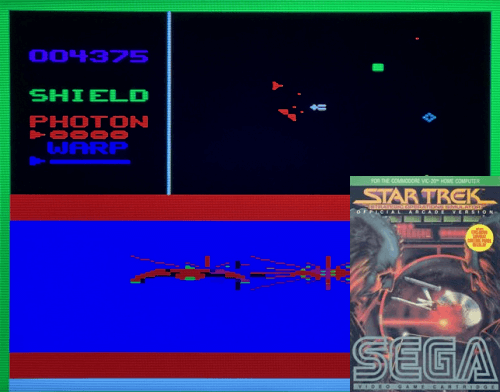
Despite its title, Star Trek: Strategic Operations Simulator is purely an arcade action game, but one that crams a fair amount of ingenuity into its simple concept. On the top left of the screen you have indicators showing your health, photon torpedoes, and warp power. On the top right, you see an overhead view of your ship and the space around it in a style very similar to Asteroids. On the bottom of the screen, you see a first person perspective from the viewscreen of your ship (I assume the USS Enterprise?) which is synchronized with the action in the top down view. Pretty nifty. You fly around these little “sectors” shooting Klingon battlecruisers who are either attacking you, or focused on attacking your starbases. You can fly to a starbase to get a small bump in health, torpedoes, and warp. Your normal attack is an unlimited, rapid fire blast that is supposed to represent your ship’s phasers, but you can also launch a torpedo which has a devastating area of effect, and warping is simply a speed boost which I actually never found all that much use for. Once you dispatch all of the enemies, hopefully saving your starbases in the process, your score is tallied up and you move to the next sector map. There are some simple boss stages every 4 or 5 sectors as well. All in all, it didn’t really hook me, but it was fun, and I can imagine some people really enjoying it.

I tried out the Commodore 64 port of the game as well, and as with most games that exist on both platforms, while the gameplay is more or less identical, the graphics and sound are greatly improved (you can actually tell what the ships are supposed to be!) and control is a little more responsive, although it’s not bad in the VIC-20 port. The experience was so much more enjoyable that I ended up playing for quite awhile, far surpassing my previous high score on the VIC-20 version. Interestingly, the original game both of these ports are based on is a 1982 Sega arcade game. The arcade game looks vaguely familiar, but I don’t think I ever played growing up. Boasting impressive hi-res vector graphics and some digitized sound samples, it looks damn cool, although the gameplay is basically the same as what is presented in the home computer versions.

Congo Bongo Commodore VIC-20

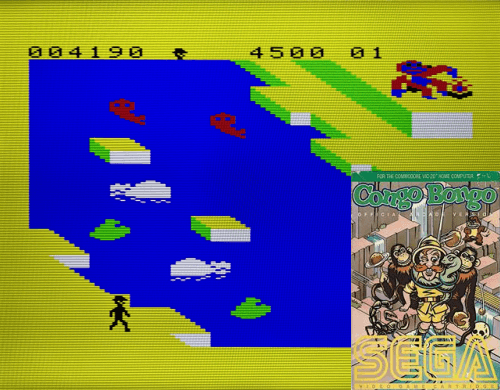
Out of the four of these games, there’s only one I had almost zero recollection of and that’s because, well, we barely played it, and we barely played it because it fucking sucked. Congo Bongo is a platformer that plays like a sloppy combination of Donkey Kong, Pitfall!, and Frogger, depending on which level you play. That is, the first level has much more of a Donkey Kong vibe, while the second brings in those Frogger elements. The key difference is that the levels are shown from something of a skewed isometric perspective. Different enough to keep the lawyers away, I guess. The wacky perspective, terrible, jumpy animations which make dodging coconuts and hopping onto moving platforms feel excruciatingly inaccurate, and the less than responsive joystick controls made a game that probably already relied a bit too much on memorization just one big bum out. I ended up beating the first stage (a feat I don’t recall if I ever managed as a kid) after about a billion tries but, running out of patience, abused TheC64’s save states to get through the second. That was it though, that’s the game! In theory, those two levels repeat with a higher difficulty 4 more times, but there’s no way I was going to go any further, at least not with this version.

This game was ported all over the place, however, and morbidly curious, I decided to check out the very similar Commodore 64 version of the game. I’m happy to report that while it looks quite close, it has more colors, better sprites, better animations, slightly better sound, and vastly superior controls. The monkeys even properly harass you in this version! Still only two levels though. Interestingly, the Commodore 64 actually had a second port released a couple of years later in 1985 which had much nicer graphics sporting a much better take on the arcade version’s isometric perspective, all 4 levels from arcade, and a lot of other original elements intact. Unfortunately the cracked dump I played glitched out on the last level so I couldn’t legitimately beat it, but hey, not too shabby! In either case, I’d have been a lot more satisfied with the Commodore 64 versions of the game than I was with this awful VIC-20 one. Honestly, the best part was the awesome box with its colorful cartoony characters and massive Sega logo.

Oh, and yes, believe it or not this game was based on an arcade game. The arcade Congo Bongo actually had beautiful graphics for the time and, while I’m sure it was still a quarter sucking kick in the balls, the gameplay looks a lot smoother. As a kid I had no idea it was ever in the arcade, and I didn’t know until researching the game for this replay that there’s actually an interesting story behind the game being something of a troll of Nintendo over a lawsuit related to Donkey Kong. I’ve never seen that event referenced before, but I wonder if that’s where the Sega and Nintendo beef all started?

Spider City Commodore VIC-20

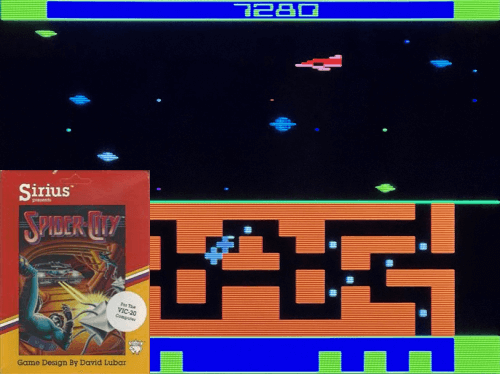
My favorite of these games as a kid was Spider City, AKA Flash Gordon. Spider City was a side-scrolling shooter, likely influenced by the arcade classic Defender. On the top half of the screen is a view of your ship, and on the bottom a sort of mini-map showing you the tunnel system you’re navigating. The map was crucial for locating your objective, the hordes of hatching spider warriors you needed to murder. Of course, you also need to avoid debris, patrol ships, and other hazards, as well as rescue captured spacemen. I remember thinking the game looked good as a kid, but… eh? Still, of these four games it does the most with the VIC’s meager sound capabilities by a longshot.

In retrospect, dazzling graphics aside, I don’t know why it appealed to me quite so much back then, other than I remember wanting to ape my brother’s deep fascination with Star Trek: Strategic Operations Simulator by diving deep into and mastering a game of my own. That said, like Star Trek: SOS, there wasn’t actually all that much to master. Fly through the map avoiding and/or shooting everything on the screen (except for spacemen, which you could fly over to rescue) and seek out the hatching pods, mow down the hatching spiders which would hopefully grant your ship a temporary shield, then rinse and repeat until the entire map is clear. There were also these “disruptor” zones which moved around the map and would fill your screen with debris when you entered one, though you could shoot the generator inside of them to freeze them temporarily if you couldn’t simply avoid them. Of course, all of these details are fairly obtuse and unintuitive, and I’m mostly only able to talk about them clearly because I read the manual.

Unlike the rest of these games, Spider City didn’t have a Commodore 64 port. In fact, the only other place it appeared was the Atari 8-bit computers. Odd, given that it’s actually fairly fun.

These days I think I probably prefer Fast Eddie to Spider City, but I still have to give Spider City major credit for being the first video game I ever loved. Additional takeaways? While I’m endlessly grateful to my dad for bringing home my first ever personal computer, I mean, I have multiple hobbies and a career to thank for my interest in computers, I definitely wish it was a Commodore 64 instead of a VIC-20. Oh well. As an aside, I’d love to make a part two to this if I can ever figure out exactly what those cassette tapes I mentioned having were. I have no idea if they were commercial releases or otherwise widely distributed, or if some dude at whatever local computer shop my dad got this stuff from cobbled them together himself. A mystery for another day. *shrug*

Apologies for the poor quality pictures – there are some major color inaccuracies, for instance. These were photos from my TV (usually at night, even) rather than actual screenshots. Box art stolen from LaunchBox’s games database.


1. Short of being able to squash Sneakers Mario style, Fast Eddie plays exactly how you might imagine from this picture.
2. Despite the silly colors, killing Klingons is serious business.
3. Frogger with a weird perspective and terrible controls? Sign me up!
4. Actually, I guess Spider City doesn’t look half bad when compared to these other games.